Reliable HDPE Geomembrane Supply, Welding and Installation in Oman
When a water reservoir leaks, an agricultural pond loses valuable
water, or an industrial containment area fails, the cost is rarely
limited to the damaged liner.
Leakage can affect construction schedules, operating budgets, soil
conditions, groundwater protection, regulatory compliance and the
long-term reputation of the project owner.
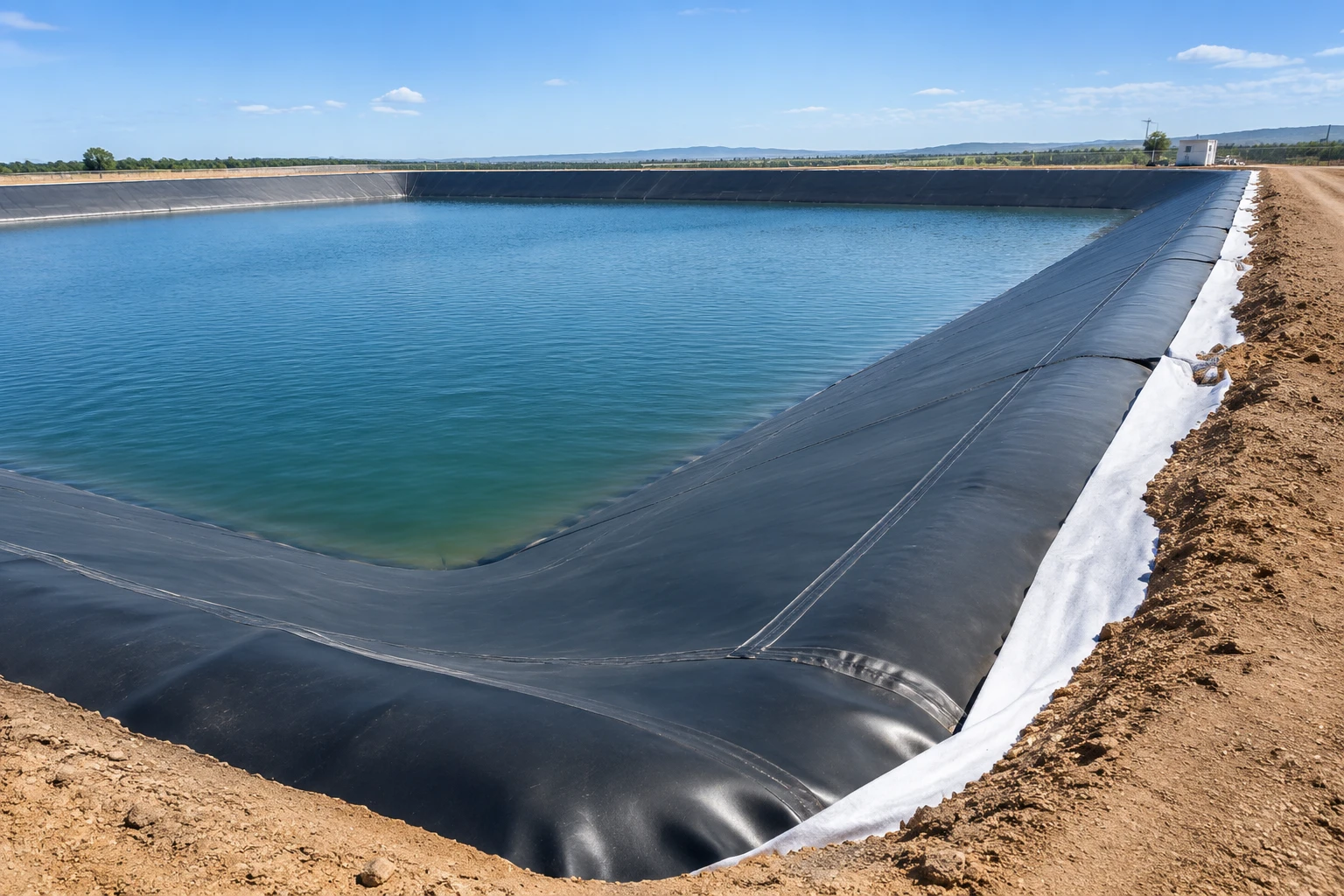
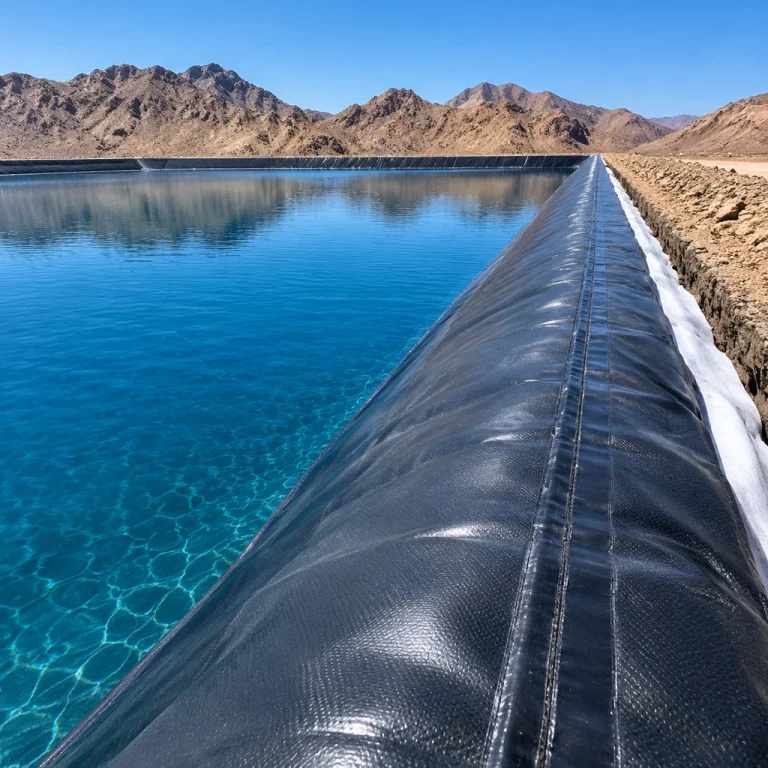
A properly selected and professionally installed
HDPE geomembrane in Oman provides a durable barrier
against water loss, chemical migration and soil contamination. It is
widely used for water reservoirs, irrigation ponds, wastewater
lagoons, aquaculture projects, landfill cells, mining applications,
industrial containment areas and waterproofing systems.
Whether you are looking for a geomembrane supplier in Muscat, a pond
liner in Oman, a landfill geomembrane liner, or a complete
supply-and-installation solution in Sohar and other regions, the
right material and installation method can significantly reduce
long-term maintenance risk.
Our objective is simple: help you choose the right geomembrane liner,
receive a technically suitable quotation and complete your project
with confidence.
Tell us about your project. Our technical team will review your requirements and contact you
Why HDPE / Oman
One Engineered Barrier. Five Reasons Oman Projects Choose HDPE.
In Oman, a lining system must perform under heat, sunlight, saline
conditions, water scarcity, rocky ground and demanding construction
schedules.
A high-quality HDPE geomembrane creates a
low-permeability barrier between the contained material and the
surrounding soil. It helps control water loss, chemical migration
and soil contamination across a wide range of residential,
agricultural, industrial and environmental applications.
The value of an HDPE liner is not determined by material price alone.
Resin quality, thickness consistency, chemical compatibility,
subgrade preparation, geomembrane welding and seam testing all
influence the long-term performance of the finished lining system.
1 / Conserve water
Unlined soil can cause significant seepage, while evaporation
already creates a natural challenge in Oman. A properly
designed reservoir liner or agricultural pond liner helps
retain water for irrigation, landscaping, aquaculture and
industrial use.
2 / Resist aggressive environments
HDPE is commonly selected for exposure to wastewater,
fertilizers, salts, hydrocarbons, leachate and other chemical
substances. Final material compatibility must be verified
against the project conditions and manufacturer data.
3 / Support long-term durability
A geomembrane sheet is an engineered barrier, not simply a
plastic sheet placed on the ground. Resin quality, carbon black
content, thickness, surface finish, seam strength and
puncture protection all affect service life.
4 / Adapt to project requirements
Different thicknesses, widths, surface textures and roll
dimensions allow HDPE liners to be used for ponds, reservoirs,
wastewater lagoons, landfill cells, industrial containment,
mining ponds, aquaculture and canal systems.
5 / Create reliable welded seams
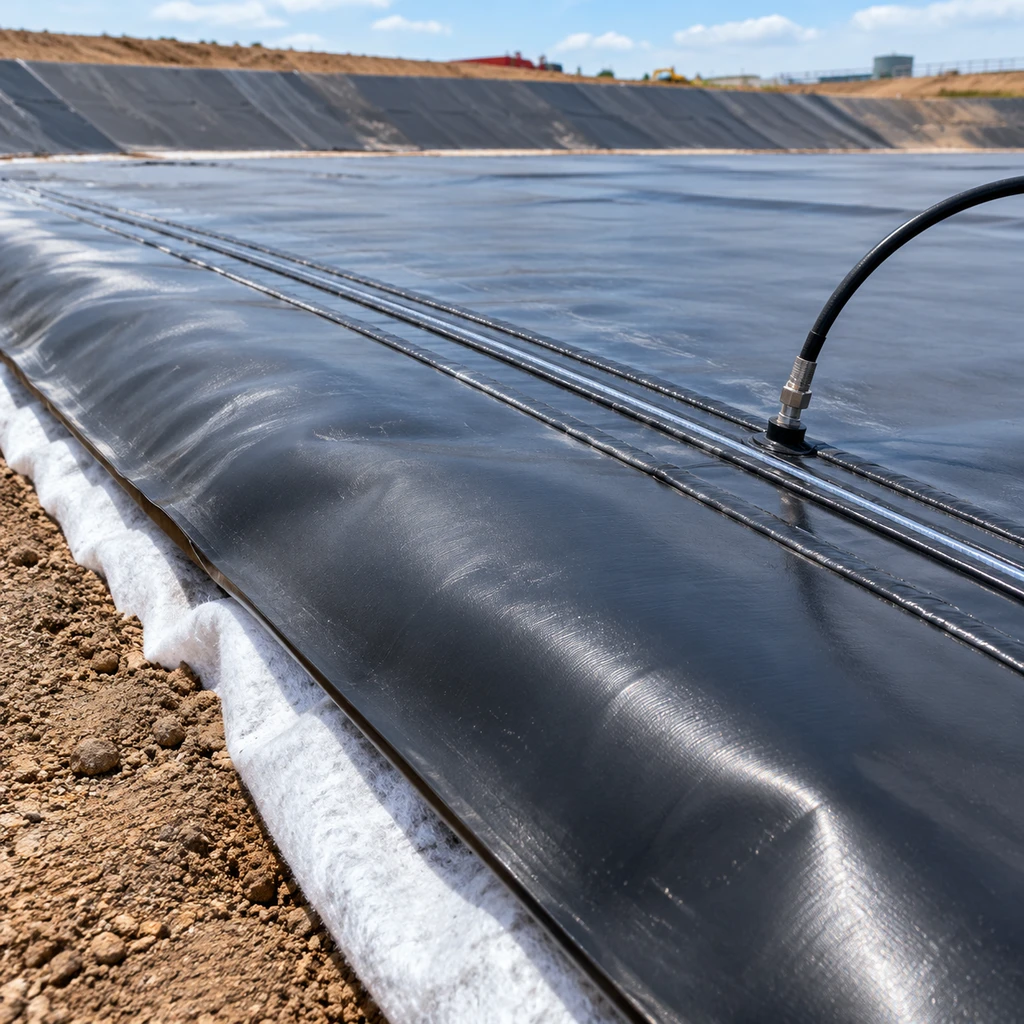
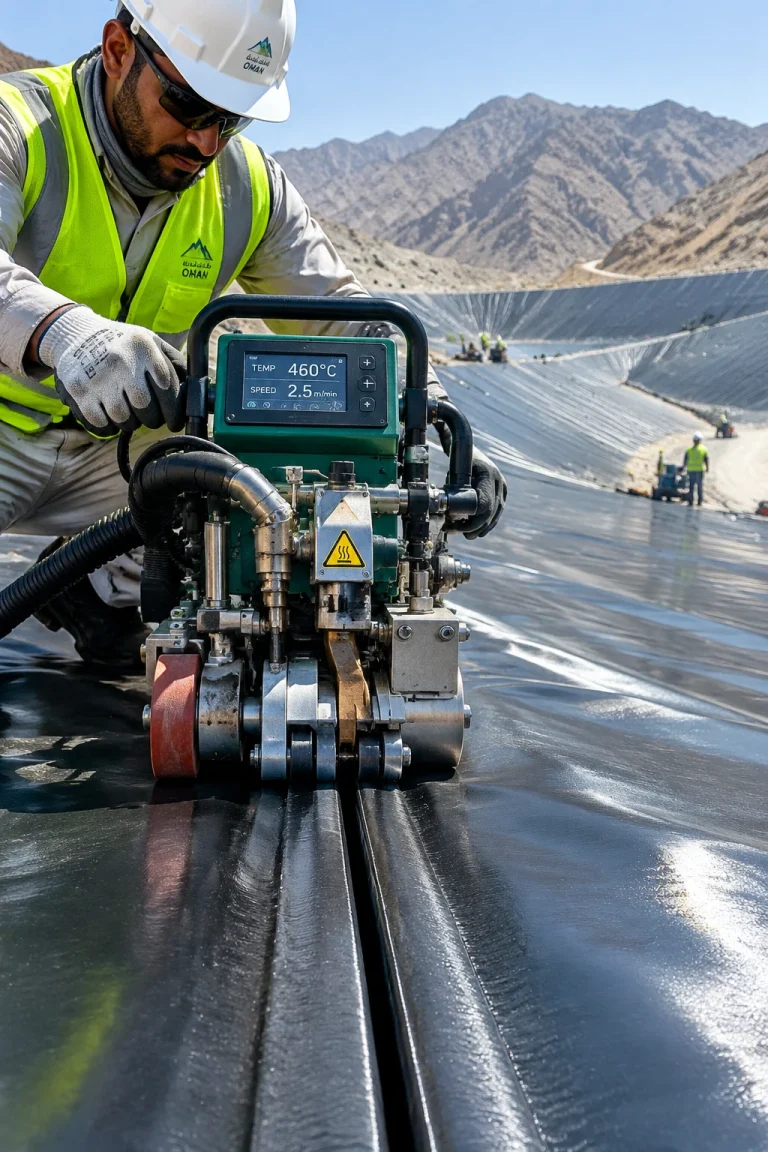
Hot-wedge welding and extrusion welding can create continuous
seams between membrane panels. Correct welding, testing and
handling are essential because good material cannot compensate
for poor installation workmanship.
Plan Your Lining System↗
Material selection, welding and installation should be evaluated
as one complete system.
WATER RETENTIONCHEMICAL CONTROLLONG SERVICE LIFEPROJECT FLEXIBILITYSEAM QUALITY
Application selector / Oman
HDPE Geomembrane Applications and Industries
Explore how project conditions shape the lining strategy, from
agricultural water storage to engineered industrial containment.
Water storage
Prepared ground and suitable protection support reliable containment.Engineered containment
Material, seams and installation work as one system.
Water management1 / 7
Agricultural pond liner in Oman
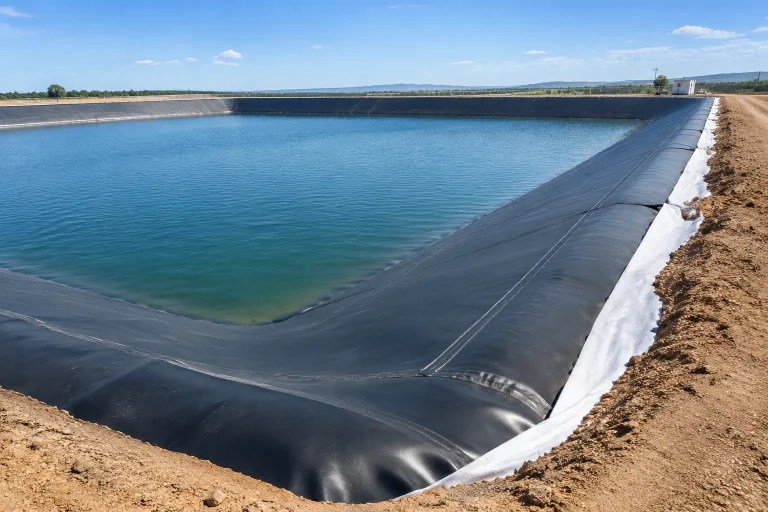
Agricultural ponds and water-storage basins can lose significant
water where natural soil permeability is high. A correctly designed
HDPE liner helps retain water for farm operations and irrigation.
Common uses
Irrigation water storage
Farm reservoirs
Date palm irrigation systems
Greenhouse water storage
Livestock water ponds
Rainwater harvesting basins
Agricultural drainage structures
Water transfer and temporary storage
Smooth HDPE may be selected for ease of deployment, inspection and
cleaning. Thickness should reflect pond size, subgrade condition,
expected traffic and puncture risk. Rocky or uneven ground may need
compacted fine soil, sand, geotextile or another approved
protective layer.
Water infrastructure2 / 7
Water reservoir liner in Oman
Large reservoirs need a lining strategy suited to temperature
variation, wind exposure, settlement and maintenance activity.
Reservoir geometry, slope angle and access conditions influence
membrane selection.
Common uses
Potable or process water storage, subject to approval
Irrigation reservoirs
Firewater storage
Industrial water ponds
Desalination-related storage
Construction water storage
Mining process-water ponds
Emergency water storage
Textured geomembranes may improve friction on slopes. Smooth sheets
may be preferred in areas where cleaning or welding access is a
priority. The choice should follow the reservoir design and site
requirements.
Aquaculture3 / 7
Fish pond liner in Oman
An HDPE liner can reduce seepage and limit interaction between pond
water and potentially unsuitable soil, supporting more controlled
pond management.
Design considerations
Compatibility with the aquatic environment
Surface cleanliness
Puncture protection
Ease of cleaning
Drainage and outlet design
Temperature exposure
Fish species and water chemistry
Local project and environmental requirements
Prepare the surface without sharp stones, construction debris or
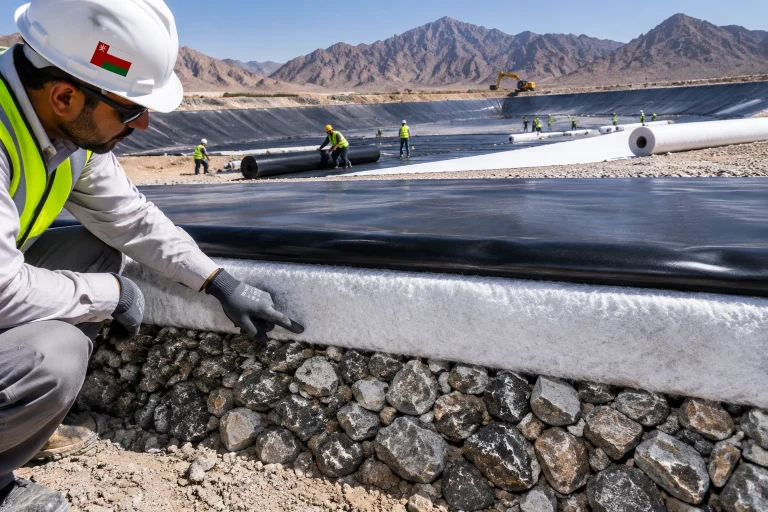
uncontrolled voids. A geotextile layer may be used beneath the
membrane where additional protection is required.
Waste management4 / 7
Landfill geomembrane liner in Oman
Landfill containment is a complete engineered system designed to
reduce leachate migration. Membrane thickness alone does not define
system performance; the surrounding layers and construction
details must also be reviewed.
Possible system components
Compacted clay or geosynthetic clay liner
HDPE geomembrane
Geotextile protection layer
Drainage composite
Leachate collection network
Gas collection components
Cover system
Leak detection system
Qualified engineers should coordinate the full design with
environmental, geotechnical and civil-construction requirements.
Smooth, textured or combined membrane surfaces may be selected
according to slope friction, drainage and welding needs.
Hydraulic structures5 / 7
Dam liner in Oman
Dam liners may be used for water-retention structures, irrigation
dams, balancing reservoirs and other hydraulic applications.
Geometry, slope stability, anchoring and drainage details all
influence long-term performance.
Review before specification
Dam dimensions and slope geometry
Exposed or covered installation
Soil movement and settlement
Anchoring details
Drainage beneath the liner
Access for welding equipment
Protection above the membrane
Protection below the membrane
Project-specific design is essential. The same membrane thickness
can perform differently on a prepared basin than on rough, rocky
or unstable ground.
Industrial protection6 / 7
Industrial and chemical containment
Industrial facilities may need containment systems for liquids,
slurries and process materials. Chemical compatibility and seam
quality are particularly important when selecting a geosynthetic
liner.
Potential applications
Wastewater and process water
Fertilizer solutions and brine
Sludge and chemical storage areas
Secondary containment zones
Firewater and emergency ponds
Mining process fluids
Industrial drainage systems
Before selecting the liner, define the contained fluid,
concentration, temperature, exposure duration and operating
conditions. Confirm chemical compatibility against project
conditions and manufacturer data.
Water treatment7 / 7
Wastewater and sewage lagoons
HDPE geomembranes can create a low-permeability barrier between
lagoon contents and the ground, helping contain wastewater and
effluent.
Potential applications
Anaerobic and facultative lagoons
Evaporation ponds
Sludge drying areas
Industrial wastewater basins
Effluent storage ponds
Leachate ponds
Secondary containment areas
The lining design should consider gas generation, differential
settlement, wind uplift, maintenance access and possible aggressive
chemical exposure.
Thickness decision system / Oman
Available HDPE Geomembrane Thicknesses
Thickness selection is one of the most important purchasing decisions.
A thicker membrane is not automatically the best solution, and a
thinner membrane is not always the most economical choice.
The correct thickness should reflect the
actual risk profile of the project.
Controlled conditions01 / 03
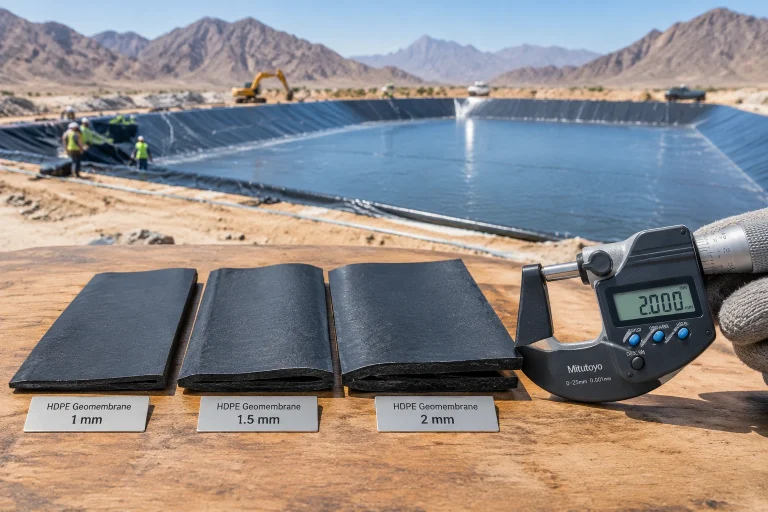
HDPE Geomembrane 1mm Oman
An HDPE geomembrane 1mm in Oman may be considered for relatively
controlled applications where the subgrade is well prepared,
the risk of mechanical damage is limited and project
requirements allow this thickness.
Suitable for lower-risk conditions
Potential uses
Small agricultural ponds
Temporary water-storage basins
Decorative water features
Low-risk lining applications
Protected membrane systems
Irrigation or landscaping projects
A 1mm membrane can be easier to handle and may reduce initial
material cost. However, it requires careful installation and
subgrade preparation. It should not be selected solely because it
has a lower price.
Balanced project profile02 / 03
HDPE Geomembrane 1.5mm Oman
The HDPE geomembrane 1.5mm in Oman is a widely considered
option for projects requiring a balance between handling,
durability and cost.
Practical middle-ground option
It may be suitable for
Agricultural reservoirs
Irrigation ponds
Fish ponds
Medium-sized water basins
Wastewater ponds
Industrial containment, subject to compatibility
Covered lining systems
Protected lining systems
The 1.5mm thickness often represents a practical middle ground.
It provides more puncture resistance and handling tolerance than
thinner products while remaining manageable for many installation
teams.
Demanding applications03 / 03
HDPE Geomembrane 2mm Oman
An HDPE geomembrane 2mm in Oman is commonly considered for
demanding applications where improved mechanical strength,
durability and puncture resistance are required.
Higher protection for demanding conditions
Potential applications
Large water reservoirs
Landfill lining systems
Industrial containment
Mining ponds
Wastewater and leachate ponds
Slopes with higher mechanical stress
Exposed outdoor applications
Demanding service-life expectations
A 2mm membrane may increase material cost and handling
requirements, but the additional investment can be justified
where the consequences of failure are high.
The project-risk principle
The right question is not simply,
“What is the cheapest HDPE geomembrane?”
A better question is:
“What membrane specification provides the lowest total project
risk over the expected service life?”
Surface selection
Smooth or textured HDPE geomembrane?
The correct surface depends on slope geometry, adjacent materials, installation conditions
and the required interface stability. Select a surface type to compare its typical role.
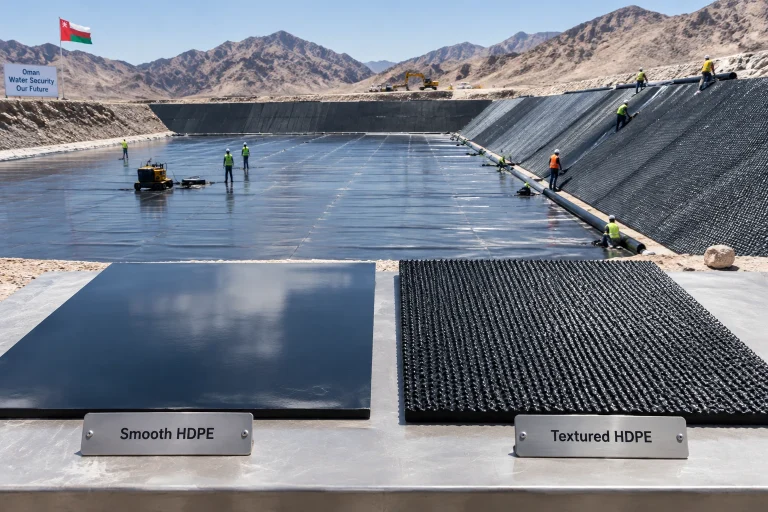
Smooth HDPE geomembrane Oman
Practical performance on horizontal surfaces
A smooth HDPE geomembrane has a flat surface on one or both sides. It is often selected
where ease of deployment, cleaning, inspection and welding are important.
Typical applications
Reservoir floors
Pond bases
Water-storage basins
Wastewater lagoons
Secondary containment floors
Covered lining systems
Potential advantages
Easier handling
Efficient hot-wedge welding
Easier visual inspection
Simple cleaning and maintenance
Lower friction during deployment
Smooth material can provide less interface friction on steep slopes. Review the slope
geometry and the interaction between the membrane and adjacent layers before selection.
Procurement review
What should buyers check before ordering?
A geomembrane quotation should be reviewed as a complete technical package, not only as a
price per square metre. Mark the items that have been confirmed by the supplier.
Raw material qualityConfirm resin type, formulation and suitability for the intended application.
Thickness consistencyReview uniformity across the sheet, not only nominal thickness.
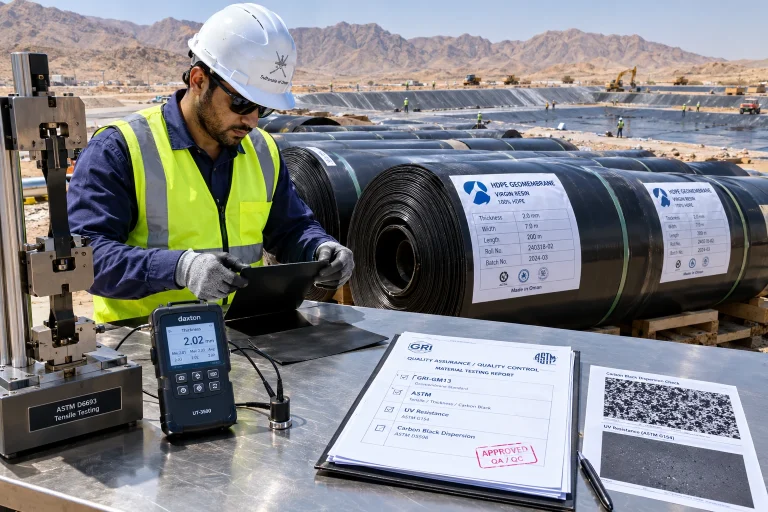
Carbon black and UV resistanceCheck suitability for intense solar exposure and expected service life.
Tensile, tear and puncture strengthMatch the values to handling, subgrade and project requirements.
Seam performanceAsk for the welding method, quality-control process and test requirements.
Non-destructive testingClarify testing methods, coverage and retesting procedures for defects.
Destructive seam testingConfirm whether destructive samples are required by the specification.
Technical data sheetObtain product properties, dimensions, tolerances and recommended use.
Factory and batch recordsRequest factory certificates, roll identification and batch information.
Delivery recordsConfirm quantities, delivery location, roll condition and receiving process.
Welding logsDefine how welding parameters, trial seams and operators will be recorded.
As-built documentationConfirm final inspection records, repairs, tests and as-built drawings.
Field execution
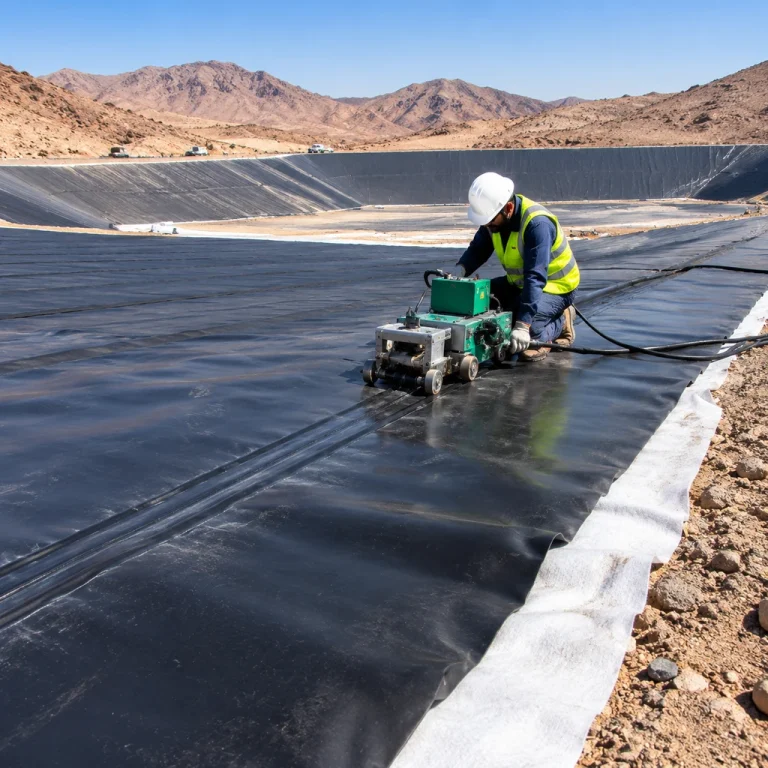
Geomembrane welding and installation in Oman
A geomembrane system contains many individual panels. The panels must be joined, tested and
protected so the final lining operates as one continuous barrier.
From prepared subgrade to final inspection
Installation quality depends on more than welding temperature. Subgrade preparation,
panel deployment, overlap, weather, access, testing and detail work all influence the
reliability of the completed system.
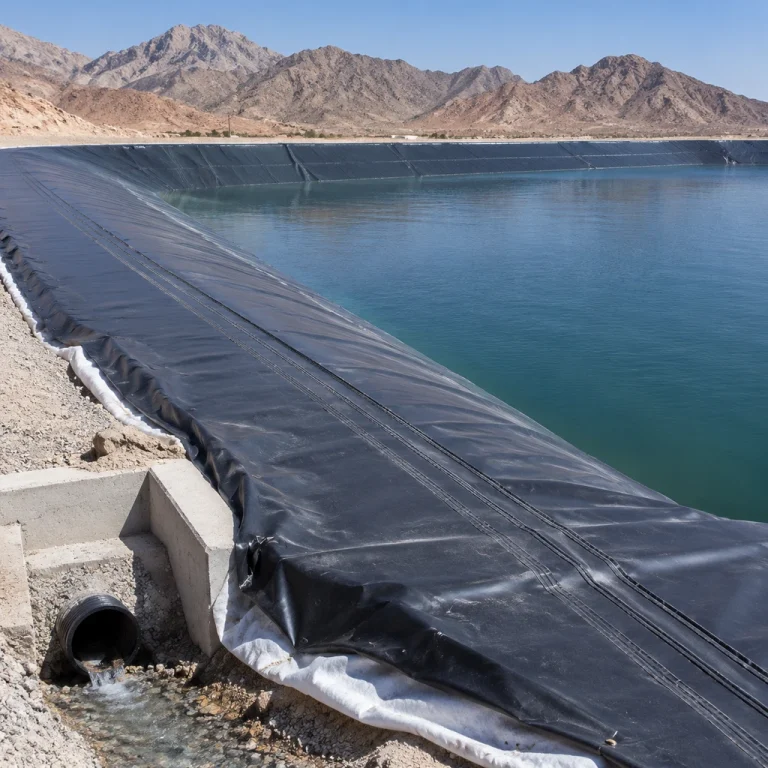
Details such as pipes, drains, corners, sumps and transitions often represent higher-risk
locations than open field seams.
Selected stage
Site assessment
Review the basin, slopes, access conditions, drainage, weather, subgrade and potential
hazards before membrane deployment begins.
Commercial clarity
What determines geomembrane price in Oman?
The delivered project cost depends on material, logistics, installation scope, site readiness
and documentation. Select a factor to understand what should be included in the quotation.
Thickness is a technical decision
A 2mm membrane generally requires more raw material than a 1mm membrane. Thickness should
be selected according to project risk, subgrade, loading, expected service life and
installation conditions.
Required thickness
Project specification
Handling and welding requirements
Expected service life
Project enquiry
Prepare a better geomembrane quotation request
A project-based enquiry helps the supplier prepare a more realistic quotation and reduces
later changes related to transport, installation, geotextile and site conditions.
Information suppliers need
Share the basic project profile before requesting a generic catalogue price. The more
complete the brief, the more useful the commercial response will be.
Project location and application
Approximate dimensions or total area
Required thickness and surface type
Installation and welding requirements
Geotextile or protection-layer requirements
Expected delivery date and site access conditions
Geomembrane Installation · Oman
Geomembrane Installation Cost and Project Planning
The cost of geomembrane installation depends on the project conditions. Important variables include:
Total surface areaNumber of panelsBasin geometrySlope steepnessNumber of penetrationsDetail complexityWeather and windSite accessibilitySubgrade readinessRequired testingInstallation crew productivityRequired protection layers
A simple rectangular pond with a ready subgrade is typically easier to install than a large reservoir with multiple slopes, pipe penetrations, sumps and irregular boundaries.
For this reason, installation should be evaluated through a site or drawing review whenever possible.
Project Classification
How Complex Is Your Installation?
Select the option that best describes the project. It helps set expectations for welding, testing and site time.
Simple installation
A straightforward geometry, few or no penetrations, gentle or short slopes, good site access and a well-prepared subgrade. Installation is typically faster and welding is repetitive.
Recommendation: confirm the classification through a site or drawing review before requesting a quotation.
Engineered installation
A designed lining system with defined slopes, some penetrations or sumps, a quality plan with trial seams and specified testing, and coordination with other site activities.
Recommendation: confirm the classification through a site or drawing review before requesting a quotation.
Complex installation
Multiple slopes and benches, several penetrations and details, irregular boundaries, demanding testing requirements, restricted access or challenging weather exposure. Installation should be evaluated through a site or drawing review.
Recommendation: confirm the classification through a site or drawing review before requesting a quotation.
Quality Control
Quality Control for HDPE Liner Projects
A professional HDPE liner project should include quality control from material delivery to final acceptance. Select a stage of the journey:
1. Material inspection
When the rolls arrive, inspect them for visible damage, correct thickness, correct roll numbers, surface defects, packaging condition and delivery documentation.
2. Storage and handling
Store rolls on a clean, stable surface. Avoid unnecessary dragging and protect the material from damage during unloading and movement.
3. Trial seams
Before production welding begins, the welding team should perform trial seams under site conditions. This helps confirm suitable temperature, speed and pressure settings.
4. Non-destructive testing
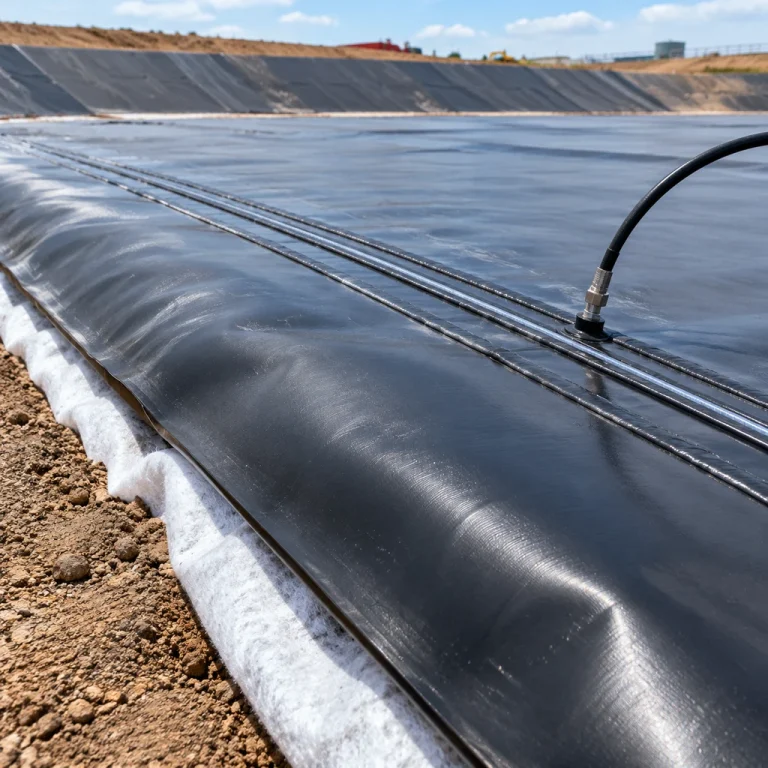
Depending on the seam type, testing may include air-channel testing, vacuum-box testing, spark testing for certain details, visual inspection and other project-specified methods.
5. Destructive testing
Test coupons may be taken from selected areas to evaluate seam strength and peel performance. The exact frequency and acceptance criteria should follow the approved quality plan.
6. Repairs
Any defect must be clearly marked, repaired and retested. The repair should be documented rather than hidden beneath cover materials.
7. Final documentation
The final project file may include material certificates, roll layout, welding logs, seam test records, repair records, inspection reports, photographs, as-built drawings and a completion certificate.
Ordering
How to Order HDPE Geomembrane in Oman
Ordering becomes easier when the project information is organized before contacting suppliers. Move through the steps to build your project brief.
Step 1 of 7Define the application
Step 1: Define the application
Tell the supplier whether the liner is intended for water storage, agriculture, fish farming, wastewater, landfill, industrial containment, mining, dam lining or decorative water features.
Step 2: Estimate the area
Provide the length, width, depth and side slopes. If possible, send drawings or a topographic layout.
Step 3: Select a preliminary thickness
You may request a recommendation for HDPE geomembrane 1mm, 1.5mm or 2mm. The final choice should be confirmed against the project conditions.
Step 4: Identify the surface type
Ask whether your project requires smooth HDPE geomembrane, textured HDPE geomembrane, or a combination of smooth and textured panels.
Step 5: Decide on supply-only or turnkey service
You can request material supply only, material plus geotextile, material plus accessories, material plus welding, complete geomembrane installation, installation and testing, or a full documentation package.
Step 6: Confirm delivery location
Mention whether the project is in Muscat, Sohar, Salalah, Nizwa, Sur, Ibri, Duqm or another location in Oman.
Step 7: Request a transparent quotation
Ask the quotation to clearly separate membrane cost, geotextile cost, accessories, transportation, installation, welding, testing, taxes and any exclusions.
Live project brief
Service Models
Turnkey Geomembrane Solutions
Many project owners prefer a single point of responsibility. Select a service model to compare:
The value is not only convenience. It is accountability. When one coordinated team manages the lining system, it becomes easier to identify responsibility, solve technical issues and maintain consistent quality — particularly for projects with complex slopes, penetrations, environmental requirements or demanding completion deadlines.
Avoid These Errors
Common HDPE Geomembrane Buying Mistakes
A thinner product may have a lower initial price but may require more careful handling and provide less resistance to puncture.
Even a high-quality geomembrane can be damaged by sharp stones and unstable ground.
Incorrect area calculations can lead to shortages, excessive waste or unsuitable panel layouts.
Smooth and textured membranes behave differently on slopes. Surface selection should be part of the engineering review.
Seam quality is central to the performance of the entire lining system.
Pipe connections, drains, overflow structures and corners should be designed before installation begins.
Construction traffic, tools, aggregate and careless backfilling can damage exposed membrane.
A low quotation may exclude transportation, geotextile, installation, testing or repairs.
Late specification changes can affect procurement, delivery and construction schedules.
FAQ
Frequently Asked Questions
An HDPE geomembrane is a flexible, low-permeability sheet made from high-density polyethylene. It is used to contain or isolate wastewater, chemicals, leachate and other materials from the surrounding soil.
In many construction and environmental applications, the terms are used interchangeably. An HDPE liner is a type of geomembrane manufactured from high-density polyethylene.
The appropriate thickness depends on the pond size, subgrade condition, risk of puncture, expected service life, exposure and budget. HDPE geomembrane 1mm, 1.5mm and 2mm may all be considered for different applications.
An HDPE geomembrane 1mm may be suitable for selected, well-controlled applications. The subgrade must be carefully prepared, and the project must not require a higher level of mechanical protection.
HDPE geomembrane 1.5mm is often considered for agricultural reservoirs, irrigation ponds, fish ponds and medium-duty containment applications. The final specification should be based on project conditions.
HDPE geomembrane 2mm may be considered for large reservoirs, landfill systems, industrial containment, mining ponds and applications where increased puncture resistance and durability are important.
Smooth geomembrane has a flat surface and is often used on floors and low-slope areas. Textured geomembrane has a roughened surface that can provide higher friction on slopes.
A geotextile may be recommended when the subgrade contains stones, rough areas or other features that could puncture the membrane. The requirement depends on the site and project design.
Long seams are commonly welded using hot-wedge equipment. Extrusion welding is often used for details, penetrations and repairs. The welding process should include trial seams and quality testing.
Installation availability depends on the project location, scope, schedule and site conditions. Include the project details in your quotation request so the installation requirement can be evaluated.
Delivery depends on product availability, quantity, transport requirements and project schedule. Projects in Muscat, Sohar and other locations in Oman can be reviewed based on the required specification.
Thickness, surface type, quantity, roll dimensions, transport, installation, testing, geotextile, accessories and project complexity all influence the final price.
No. A low purchase price may not reflect installation risk, material quality, documentation, transport, testing or expected service life. Total project cost should be considered.
Potentially, but the product must be specifically approved for the intended potable-water application and comply with applicable project and regulatory requirements. Do not assume that every HDPE geomembrane is suitable for drinking water.
HDPE geomembrane can be installed in hot climates, but temperature, wind and panel expansion must be managed. Welding parameters may need adjustment, and the installation team should follow an approved method statement.
Yes, HDPE geomembrane is commonly used in landfill containment systems. However, landfill projects require a complete engineered system, including drainage, leachate collection, protection and quality control.
Provide the project location, application, approximate area, dimensions, desired thickness, surface type, installation requirement, geotextile requirement and expected delivery date.
Final Call to Action
Request a Technical Quotation Today
Your project may require a simple pond liner, a high-performance water reservoir or landfill geomembrane system, or a complete industrial containment solution. In each case, the most reliable result begins with the correct specification — not a single price number.
Ask for a quotation that explains which membrane is proposed, why the thickness is suitable, whether the sheet is smooth or textured, what protection is required, how the seams will be welded, how the installation will be tested, what is included in the price, what is excluded, and how delivery will be managed in Oman.
Whether you are searching for HDPE geomembrane Oman, geomembrane Oman, geomembrane suppliers in Oman, pond liner Oman, HDPE liner Oman, geomembrane sheet Oman, geotextile Oman, geosynthetics Oman, or geomembrane installation Oman, our team can review your requirements and recommend the next practical step.
Send Your Project Details
To receive a project-based quotation, send your project name, location, application, approximate area, required thickness, surface and installation requirements, geotextile requirement, desired delivery date and any drawings or photographs:
Project name
Project location
Application
Approximate area
Required thickness
Smooth or textured requirement
Installation requirement
Geotextile requirement
Desired delivery date
Drawings or photographs
Need an HDPE Geomembrane Supplier in Oman? From a small agricultural pond to a large industrial, landfill or water-storage project, the right liner can reduce seepage, protect the surrounding soil and support reliable long-term operation. Protect your water, land and investment — request your HDPE geomembrane quotation in Oman today.